Do Seams Make Leggings More or Less Squat Proof?
Quick Answer: Seams generally make leggings more squat proof, not less. Seamless leggings are knit as a single tube with varying stitch density, which means the fabric across the seat is often deliberately thinner and more open for stretch — the exact place opacity fails. Well-placed seams let a brand use a denser, thicker panel exactly where the stretch load is highest. The tradeoff is that seams can chafe and can show under close-fitting clothes, which is why seamless dominates the marketing despite the opacity disadvantage.
You bought the seamless pair because it looked more expensive and had no visible construction lines, and it went sheer in your first deep squat.
That is not bad luck. It is a direct consequence of how seamless garments are made — and the specific failure point in the third section is where nearly every one of them gives out.

What is actually different about seamless construction?
Seamless leggings are knit in the round on a circular machine as a continuous tube, with the shaping built in by varying the knit structure rather than by cutting and joining panels.
That produces genuine advantages: no seam to chafe, a very smooth surface with nothing showing through fitted clothing, and a close body-following fit with excellent stretch in every direction.
It also produces a specific weakness. To create shaping and stretch zones without seams, the machine varies stitch density — tighter in some areas, more open in others. The open zones are typically placed where the garment needs the most give, which on leggings means across the seat and the back of the thigh.
Those are exactly the areas that stretch most in a squat. So the construction has, by design, put its thinnest fabric where the greatest stretch load occurs.
Seamed leggings work the opposite way. Flat panels are cut and joined, which lets a brand use a heavier, denser fabric for the seat panel specifically, and place the seams to direct stretch away from the areas that need to stay opaque. A gusset in the crotch removes the four-way seam intersection that is otherwise a stress and failure point.
Which construction should you buy for which use?
Choose seamed when
Opacity is the priority. Deep squats, hip thrusts, wide-legged forward folds, floor work, anything where a mirror or another person is behind you.
You want compression. Panelled construction allows targeted compression zones — firmer through the waist and thigh, more give at the knee — which seamless cannot replicate as precisely.
You want them to last. A well-constructed seamed legging with flatlock seams and a gusset generally outlasts a seamless one, because the seams distribute load rather than concentrating it in a knit structure.
You are buying light colors. Light colors are less forgiving of any thinning, so construction matters more.
Choose seamless when
Comfort against the skin is the priority. Long runs, long wear, sensitive skin, or anywhere chafing is your recurring problem.
Nothing should show through outer clothes. Under fitted dresses and close-cut trousers, seamless is genuinely better.
Your training is not stretch-intensive. Walking, light cardio, upper-body work, pilates on a reformer — the failure mode never gets triggered.
The best of both
A number of brands now produce seamed leggings with bonded or laser-cut seams, which are flat, essentially invisible from the outside, and do not chafe — while still allowing panelled construction and a dedicated seat panel. If you can find them, they resolve the tradeoff almost entirely.
What Nobody Tells You: it is the seat panel, not the seams, that decides it
Here is the thing that actually predicts opacity, and it applies to both constructions.
Look at the fabric across the seat under stretch — everything else is secondary.
The mechanism is simple. Knit fabric goes sheer when the yarns are pulled far enough apart that light passes between them. Whether there are seams nearby is irrelevant; what matters is how much fabric is there and how much it has to stretch.
Two things determine that.
Fabric weight. Measured in gsm, and rarely published, which is why the hand test matters. A squat-proof legging is generally in the 250 to 320 gsm range. Lightweight running leggings at 180 gsm will not be reliably opaque in a deep squat regardless of construction.
How much stretch the garment is under at rest. A legging that is already stretched to 80 percent of its capacity just standing has very little left before it goes sheer. This is why sizing down is the most common cause of a squat-proof failure — the same garment in the correct size passes and in one size smaller does not.
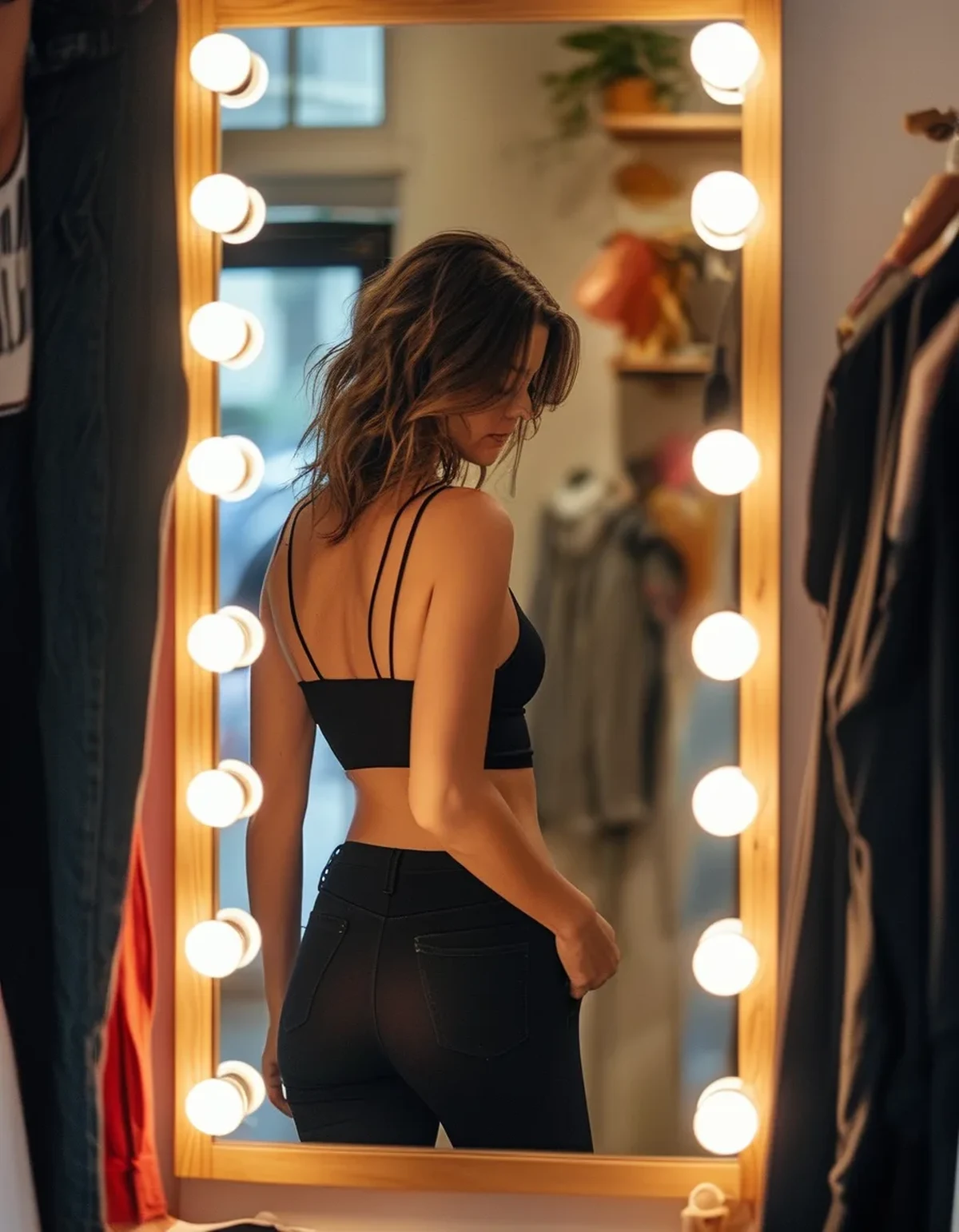
The test that settles it, and it works in any fitting room: do a full squat facing away from a mirror and look back over your shoulder. Not a partial bend — full depth. Any lightening of the color across the seat is a fail.
The version people get wrong is testing at home under bathroom lighting and then failing in a class. Gym lighting is usually brighter and often comes from above and behind, which reveals thinning that a bathroom mirror does not. If you can, do the check under the brightest light in your house, or have someone photograph you from behind with a flash. It is an unglamorous two minutes that saves an unpleasant discovery in a squat rack.
Cold matters too, and this is the season for it. Elastane stiffens in cold conditions, so a legging in a cold studio behaves slightly differently — a bit less give, which means slightly more localized stretch at the point of greatest load. Pairs that were marginal in a warm summer studio are worth re-testing when the studio gets cold.
Myth vs Fact: legging construction
Myth: Seamless means higher quality. Fact: It means a different manufacturing process. Some seamless leggings are excellent and some are thin. Construction type says nothing about quality on its own.
Myth: Seams are where leggings go see-through. Fact: The seams themselves are the thickest part of the garment. Sheerness happens in the fabric field between them, which is why the seat panel is what to inspect.
Myth: A gusset is a cosmetic detail. Fact: A gusset removes the point where four seams would otherwise meet at the crotch, which is the single most common place seamed leggings split. Its presence is one of the better quick indicators of construction quality.
Myth: Black is always squat proof. Fact: Black hides thinning better than light colors, and it still fails — it just fails as a visible sheen or a lighter patch rather than as obvious transparency. Under bright overhead lighting, thin black fabric is noticeably see-through.
Myth: If it passes when new, it will keep passing. Fact: Elastane degrades, particularly from heat. Dryer heat and hot washes are the fastest route to a pair that used to pass and no longer does. Wash cold, hang dry, and skip fabric softener.
FAQ: Legging Construction Questions, Answered
How do I judge fabric weight without a label?
Hold the fabric up to a light with a single layer stretched between your hands, pulling to roughly the stretch of a deep squat. If you can clearly see the light source through it, it will not be opaque under load. This works through packaging in a shop and is a better test than how the fabric feels in your hand.
Do flatlock seams make a difference for chafing?
Yes, substantially. Flatlock seams lie flat against the skin rather than creating a raised ridge, and they are the standard on well-made seamed activewear. If you are avoiding seamed leggings because of chafing from an old pair with overlocked seams, flatlock construction is worth another try.
Why does the same brand’s seamless pair fit differently from the seamed one?
Because they are made on completely different machinery with different fabrics and different sizing logic. Circular-knit seamless garments have their own size grading, and a brand’s seamed size 8 and seamless size 8 are frequently not the same measurement. Treat them as separate products and check each independently.
TL;DR:
- Seams usually help opacity — panelled construction lets a brand put denser fabric exactly across the seat.
- Seamless is knit as one tube with thinner stretch zones, often placed where the squat load is highest.
- What actually predicts squat-proofness is fabric weight across the seat and how much stretch the garment is already under — which is why sizing down causes most failures.
- Test with a full squat under the brightest light you have, not a partial bend in a dim bathroom.
Buy seamed for the squat rack, seamless for under a dress, and bonded-seam pairs if you would rather not choose.
See It in Motion
Seen here: High Waist 8” Yoga Shorts — shop similar styles on bubblelime.com
Keep Reading
This article is for general informational and styling purposes only. Fit, sizing, and product availability may vary.