Do Squat-Proof Leggings Perform Differently in a Cold Studio?
Quick Answer: Elastane loses elasticity as temperature drops, so leggings feel stiffer and stretch less evenly in a cold studio. Less even stretch means the fabric thins more at the points where it does give — which can make a pair that passed every summer test show more at depth in October. The pair didn’t change; the ambient temperature did.
Same leggings, same squat, and suddenly you’re not sure about them. Cold fabric behaves differently, and the studio in October is not the studio in July.
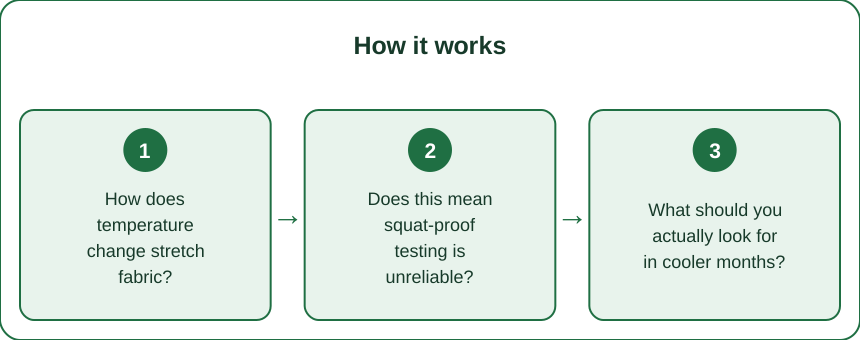
How does temperature change stretch fabric?
Elastane is a polymer, and polymer elasticity is temperature-dependent in a way most people never think about.
Cold makes elastane stiffer. The molecular chains that give the fiber its recovery move less freely at lower temperatures, so the fabric resists stretch more and returns more slowly. At studio temperatures this is a subtle effect, not a dramatic one — but squat-proofing operates on narrow margins.
Stiffer fabric distributes stretch less evenly. In a warm, compliant state, a knit spreads deformation across a wide area. When it’s stiffer, more of the stretch concentrates at the points of highest load — across the seat at depth, and around the knee. Concentrated stretch means locally thinner fabric, which is exactly the mechanism behind see-through at depth.
Recovery lags too. Cold fabric returns to shape more slowly, so the bagging at the knee that used to disappear between sets lingers longer.
The effect reverses within minutes of moving. Body heat warms the fabric against your skin quickly once you’re working. Which means the risk window is the first few minutes of class — the warm-up squats, before the fabric has come up to temperature.
Why this reads as a quality problem
People test leggings in a warm bedroom or a heated store fitting room, where the fabric is at its most compliant. That’s the best-case condition, and it’s not the condition they’ll be squatting in on an October morning.
Does this mean squat-proof testing is unreliable?
It means the standard mirror test is testing the wrong conditions, not that it’s useless.
The mirror test at home is done warm and static. You stand in a heated room, squat once, and look. The fabric is warm, unstretched by prior movement, and you’re holding a position rather than moving through one.
Class conditions are cooler, dynamic, and repeated. Fabric that’s fine on one held squat can show on the twelfth rep, because repeated loading progressively thins the highest-stress area before recovery catches up — and cold recovery is slower.
Lighting is the other half of the problem. Studio lighting is frequently brighter and more directional than home lighting, and downlights hitting a stretched seat is the worst possible case. This is entirely separate from temperature and it compounds it.
A better test: squat ten times in a row, then check — in the coolest room you have, in the brightest light available. If it passes that, it passes a class.
The bend-and-hold version is also worth doing: touch your toes and hold for five seconds. Sustained stretch reveals more than a quick squat, and sustained positions are common in class.
What should you actually look for in cooler months?
The same properties that matter year-round, weighted differently.
Higher fabric weight. Anything below roughly 200 gsm is working with a thin margin, and cold conditions eat that margin. Mid-weight fabric — 220 to 280 gsm — has the density to stay opaque under concentrated stretch. It’s also warmer, which matters independently in autumn.
Elastane percentage in the 18–25% range. Lower and you get insufficient recovery; higher and the fabric can be over-elastic and thin at stretch. Most well-made squat-proof leggings land in this band.
Dark, saturated colors. Not a construction fix, but light colors and heathered grays show stretch thinning far more readily under bright light. Nearly every legging is more opaque in black.
Interlock or double-knit construction over single jersey. Interlock has two interlocked layers of loops, which means far more material at any given stretch. This is the single most reliable structural indicator and it’s often listed in the product description.
A gusset and flatlock seams — not for opacity, but because they’re markers of a manufacturer that engineered the garment for movement rather than for a photograph.
One thing to stop doing
Buying a size down for a tighter look. A legging worn at higher baseline stretch has less headroom before it thins, and cold conditions reduce that headroom further. Correct size, mid-weight fabric, dark color — in that order.
What Nobody Tells You About Squat-Proof Fabric
It degrades before it looks worn. Elastane loses recovery gradually with washing and heat. A legging that’s visually fine at 18 months may be well past its useful opacity, because the fabric now sits at a higher baseline stretch when worn.
Tumble drying is the fastest way to ruin it. Heat degrades elastane directly. Cold wash and hang dry roughly doubles the life of the property you paid for, and it’s the single most cost-effective habit in an activewear rotation.
Fabric softener actively harms performance fabric. It coats fibers, reducing both moisture management and elastic recovery. Skip it entirely on activewear.
The same pair fits differently across a day. Normal fluid shifts mean leggings sit tighter in the evening, which is a real effect and a reason a fitting-room verdict at 6pm differs from a 7am class.
Pilling is a different failure from thinning. Pilling is surface abrasion, usually from friction with other fabrics in the wash or from a bag. It looks worse than it is. Thinning at the seat is the one that matters, and it’s much less visible until you’re at depth.
Brands are inconsistent across their own lines. The same brand’s high-weight training legging and its lightweight summer legging behave completely differently. “This brand is squat-proof” is not a reliable statement — the specific style is what matters.
FAQ: Cold-Weather Legging Questions, Answered
Does the studio temperature really change opacity?
Marginally, through stiffer elastane concentrating stretch. The effect is small but squat-proofing works on small margins, so it can push a borderline pair over.
How long until the fabric warms up during class?
Usually two to five minutes of movement. The warm-up is the risk window, not the main set.
What fabric weight is safe?
220 gsm and up is a reliable range. Below 200 gsm, expect a narrower margin regardless of brand.
Is interlock knit worth looking for specifically?
Yes — double-knit construction puts substantially more material at any stretch level than single jersey.
Do I need different leggings for winter?
Not necessarily different, but a mid-weight pair serves autumn and winter better than a lightweight summer pair on both opacity and warmth.
How often should I replace them?
When recovery declines — bagging at the knee that doesn’t spring back. Typically 12–24 months with regular use and proper washing.
TL;DR:
- Elastane stiffens in cool air, concentrating stretch at the highest-load points instead of spreading it
- Concentrated stretch means locally thinner fabric, which is the see-through mechanism
- The risk window is the first few minutes of class, before body heat warms the fabric
- Test with ten reps in the coolest, brightest room you have — not one squat in a warm bedroom
- Prioritize 220+ gsm, interlock knit, dark color, and correct size over a tighter fit
- Cold wash and hang dry; heat and fabric softener destroy elastane recovery
Nothing is wrong with the leggings. They’re being asked to perform at a temperature you never tested them at.
See It in Motion
Seen here: High Waist Yoga Leggings with Inner Pocket — shop it on bubblelime.com
Keep Reading
This article is for general informational and styling purposes only. Fit, sizing, and product availability may vary.