Does Fabric Softener Ruin Squat-Proof Leggings?
Quick Answer: Yes - fabric softener is one of the fastest ways to shorten the squat-proof life of leggings. It works by depositing a waxy cationic coating on fibres, and on synthetics that coating fills the gaps between yarns, traps body oils, and reduces elastane recovery. The visible result is fabric that relaxes more at the seat, stays stretched, and goes sheer sooner. Skip softener entirely, skip dryer sheets, wash cold, and air dry - that alone typically doubles usable life.
Here is the mechanism, and the full list of what actually matters in the wash.

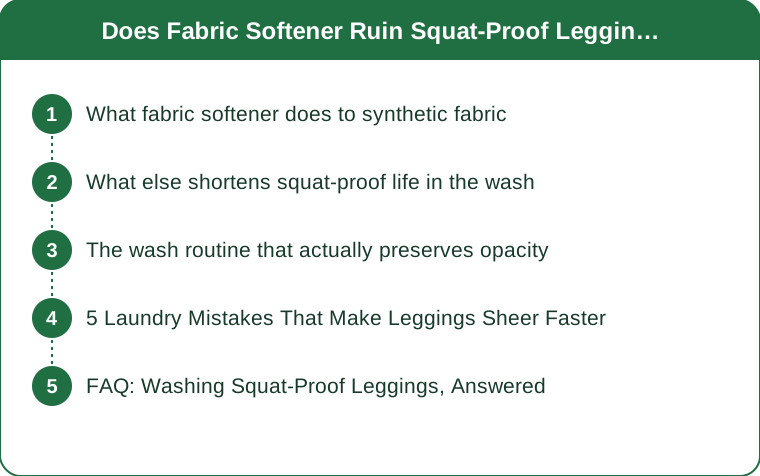
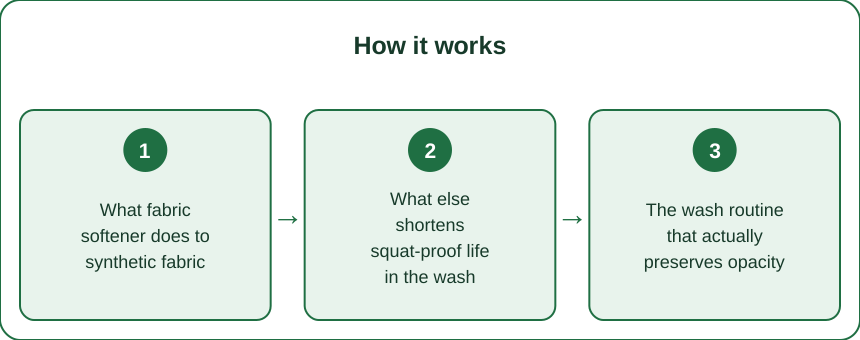
What fabric softener does to synthetic fabric
Softener is designed for cotton, and it works by coating fibres in a waxy cationic layer. On cotton that layer lifts flattened fibres and feels soft. On nylon and polyester there is nothing to lift - the coating just sits there.
That coating reduces the fabric’s ability to move moisture. Squat-proof performance depends partly on the fabric not becoming saturated at the seat, and a waxed surface both repels and then holds sweat unevenly rather than wicking it away.
It also degrades elastane recovery over time. Elastane - the spandex or Lycra component - is what pulls the knit back to shape after each squat. A coated, oil-loaded elastane recovers less completely, so the knit stays slightly stretched, and a stretched knit is a thinner knit.
Thinner knit at the seat is exactly what sheerness is. Opacity is a function of how much fabric sits between the light and your skin. Anything that permanently opens up the knit structure makes the fabric more see-through, and softener does it slowly and invisibly.
Dryer sheets do the same thing by a different route. They transfer the same coating in the dryer, with heat added - which is separately bad for elastane. If you skip liquid softener but use sheets, you have not solved anything.
And the smell problem is downstream of the same coating. Trapped body oils are what make activewear smell persistently even after washing. Softener makes oil removal harder, which is why softener-washed gym clothes often smell worse, not better.
What else shortens squat-proof life in the wash
Hot water is the biggest one after softener. Heat relaxes elastane and accelerates its breakdown. Cold water washes activewear perfectly well - modern detergents are formulated for it - and there is no performance reason to use warm.
The tumble dryer is the second biggest. Dryer heat is far more aggressive than wash-water heat, and a single hot cycle can do more elastane damage than several washes. Air drying flat or on a rack costs nothing but time.
Too much detergent leaves residue. Excess surfactant does not rinse out fully and builds up in the knit much like softener does. Use roughly half of what the cap suggests for a normal activewear load - it is genuinely enough.
Washing with towels or denim causes abrasion. Rough fabrics pill the surface of smooth technical knits, and surface pilling at the seat is where thinning shows first. Wash activewear with activewear.
Leaving sweaty leggings in a bag overnight matters more than people expect. Prolonged damp contact with body oils and bacteria degrades the fabric and sets odour - rinse or wash within a few hours where you can.
And bleach or oxygen bleach is straightforwardly destructive to elastane. Nothing in a normal activewear wash requires it.
Turning leggings inside out is worth doing. The inside is the surface that carries oils, so inside-out washing cleans the dirty face directly and protects the outer face from abrasion at the same time.

The wash routine that actually preserves opacity
Wash inside out, cold, on a normal or delicates cycle, with about half the recommended detergent and no softener. That single sentence is most of it.
Air dry, ideally flat or folded over a rack rather than hanging by the waistband. Hanging wet leggings by the waist puts sustained load on the elastic and stretches the panel that holds everything else in place.
Use a sports detergent occasionally, not always. Enzyme-based activewear detergents strip accumulated body oils better than standard ones. Once every four or five washes is enough - they are not needed every time.
Do a vinegar rinse if softener has already been used. Half a cup of white vinegar in the rinse strips existing coating buildup without harming synthetics. One cycle usually restores much of the wicking.
Rotate pairs rather than wearing the same one repeatedly. Elastane needs time to recover fully, and 24 hours off between wears measurably reduces bagging - which is the same mechanism as sheerness.
Skip the fabric shaver on the seat. Shaving pills off a thinning area removes fibre, and removing fibre from the exact place that is going sheer makes the problem permanent.
And know when a pair is done. Once the knit at the seat has visibly relaxed and stays relaxed after washing, no laundry routine brings it back. Care extends life; it does not reverse structural stretch.
5 Laundry Mistakes That Make Leggings Sheer Faster
1. Using softener because the leggings feel scratchy. Scratchiness in synthetics is usually detergent residue, not a lack of softener. The fix is less detergent and a second rinse, not a coating.
2. Washing warm because the load is sweaty. Sweat is water-soluble and cold water handles it. Warm water buys you nothing and costs elastane life on every single cycle.
3. Tumble drying on low and assuming low is safe. Low is better than high and still worse than air. The dryer is the single largest heat exposure a pair of leggings gets.
4. Overloading the machine. A packed drum means poor rinsing, so residue stays in the fabric - which produces exactly the stiffness that makes people reach for softener in the first place.
5. Hanging them wet by the waistband. Wet fabric is heavy, and hours of that load stretches the waistband permanently. Fold over a rail or dry flat instead.
The bonus mistake is buying a replacement without diagnosing the failure. If every pair goes sheer at the same point in their life, the laundry routine is the variable, not the brand - and replacing them at higher cost changes nothing.
FAQ: Washing Squat-Proof Leggings, Answered
Does fabric softener really make leggings see-through?
Indirectly but reliably. It coats synthetic fibres, traps body oils, and reduces elastane recovery - so the knit stays slightly stretched, and a stretched knit is a thinner, more transparent one.
Are dryer sheets any better than liquid softener?
No. They deposit the same type of coating with heat added, so they combine both problems in a single step.
Can I undo fabric softener buildup?
Largely, yes. Run a wash with about half a cup of white vinegar in the rinse and no detergent. That strips the coating without damaging synthetics. It will not restore knit that has already stretched out.
What temperature should I wash activewear at?
Cold. Modern detergents are formulated to work cold, sweat is water-soluble, and every degree of heat shortens elastane life.
How much detergent should I use?
About half what the cap suggests. Excess surfactant does not rinse out and builds up in the knit, which causes the stiffness people mistake for needing softener.
Does air drying really make a difference?
It is the single highest-value change after dropping softener. Dryer heat is far more aggressive on elastane than anything in the wash cycle.
How long should a good pair of leggings stay squat-proof?
With cold washing, no softener, and air drying, expect a couple of years of regular use. With hot washing, softener, and tumble drying, the same pair can go sheer within a few months.
TL;DR:
- Fabric softener genuinely shortens squat-proof life. It coats synthetic fibres, traps oils, and reduces elastane recovery, which thins the knit at the seat.
- Dryer sheets do the same thing with heat added - skipping liquid softener but keeping sheets solves nothing.
- Wash inside out, cold, half the detergent, no softener, air dry. That is the whole routine.
- Never hang wet leggings by the waistband - fold them over a rail or dry flat.
- A vinegar rinse strips existing buildup if softener has already been used.
- Rotate pairs. Elastane recovers better with 24 hours off between wears.
- Care extends life but does not reverse structural stretch. Once the seat stays relaxed after washing, it is done.
If every pair fails at the same point regardless of brand or price, the laundry routine is the variable - and buying more expensive leggings will not change it.
See It in Motion
Seen here: High Waist Yoga Leggings with Inner Pocket — shop it on bubblelime.com
Keep Reading
This article is for general informational and styling purposes only. Fit, sizing, and product availability may vary.