The Activewear Quality Test: How to Judge Leggings and Tops Before You Buy
Every woman has funded the activewear industry’s returns department: the leggings that turned translucent at the first squat, the sports top that surrendered its shape by wash five, the set that pilled into fuzz before summer ended. Quality in activewear is testable — before purchase, with a repeatable protocol — and the tells are consistent across price points, which is exactly why some $30 pieces outperform $110 ones. Here is the full testing manual. Consider this lab open.

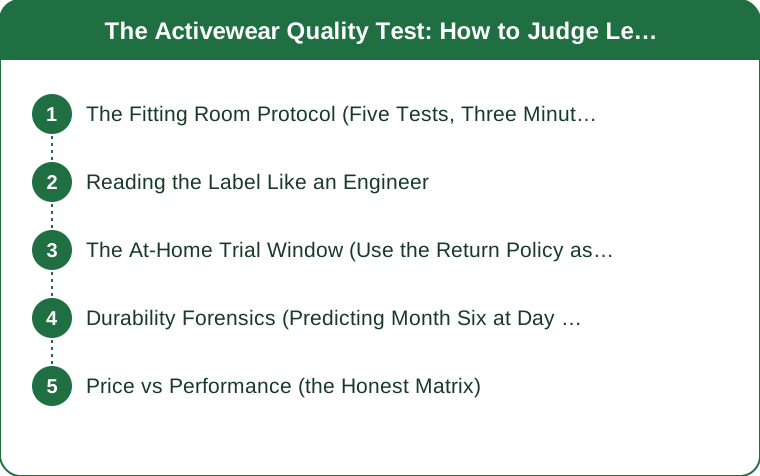
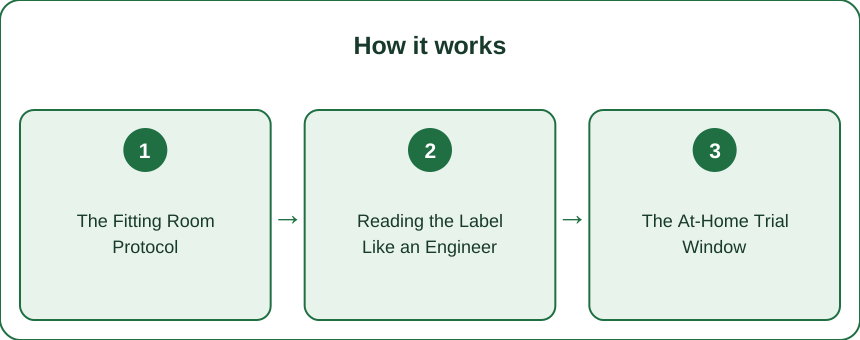
The Fitting Room Protocol (Five Tests, Three Minutes)
The in-store gauntlet: the stretch-and-see (stretch fabric over your hand toward the light — if you can see skin tone through it relaxed-adjacent, squats will broadcast; opacity at stretch is the whole question), the deep squat in the mirror (full depth, daylight-adjacent lighting, checking sheerness and waistband behavior), the bend-and-reach (forward fold: does the waistband gap or migrate?), the seam inspection (gusset present? flatlock seams? loose threads at stress joints are shipped-quality confessions), and the recovery pinch (stretch a small section hard, release — quality snaps back instantly; slow recovery predicts baggy knees by month two). Any piece failing two of five goes back on the rack regardless of brand or price.
Reading the Label Like an Engineer
The fabric-content decode: nylon-spandex blends with 20%+ spandex signal performance intent; under 15% spandex in a training legging is a red flag for recovery; polyester-dominant is legitimate (color-fast, quick-dry) but check softness expectations; cotton in a sweat garment is a category error. The weight tell: quality compression fabric has heft — the whisper-light legging that costs $98 is charging for brand, not material. And the care-label confession: wash cold, hang dry is normal; a garment with elaborate care demands is telling you its fragility in advance. Labels are the one place activewear cannot market. Read them first.

The At-Home Trial Window (Use the Return Policy as a Lab)
Retail truth: the real tests need a living room, and return policies are your laboratory — keep tags on and run the full protocol within the window: the workout simulation (thirty minutes of actual movement: squats, lunges, floor work, a jog in place — checking migration, chafe points, opacity in motion and whether the waistband needs mid-session diplomacy), the sit test (fifteen minutes seated — where bad waistbands dig and cheap fabrics bag), and the crucially underused first-wash test (cold, gentle, hang dry, then re-inspect: color bleed, shape change, seam behavior — a garment that degrades on wash one just told you its whole biography). Buying is the hypothesis. The window is the experiment.
Durability Forensics (Predicting Month Six at Day One)
The aging predictors: pilling risk lives where friction lives — inner thighs, under arms, wherever a bag strap crosses; check those zones on the rack for early fuzz on floor models (floor models are accelerated-aging exhibits — inspect them gratefully), elastic quality shows at the waistband fold (crackled or wavy elastic on a new garment is a countdown timer), printed patterns hide construction sins but crack along stress lines on cheap bases (stretch a printed section and watch the ink), and hardware — zippers, drawcords, bra clasps — is where cost-cutting hides first. The meta-tell: brands that publish fabric weights and composition percentages are signaling confidence; brands leading exclusively with lifestyle photography are signaling photography.
Price vs Performance (the Honest Matrix)
The verdict framework from accumulated testing wisdom: price correlates with quality loosely and brand-dependently — the $25–45 tier contains genuine performers (test hard, expect occasional lottery losses), the $50–90 tier is where consistency lives (established performance lines earn their reputations on fabric R&D and QC), and above $100 you are increasingly buying design, community and logo — sometimes worth it, never confuse it with durability data. The universal strategy: test protocols over brand loyalty (lines change fabric suppliers; last year’s holy grail is this year’s gamble), buy proven pieces in multiples when found (the repurchase is the highest-information buy in retail), and let cost-per-wear — not sticker price — keep the books. A $70 legging worn 150 times beats a $30 one retired at 20, and both lose to the $45 pair that passed every test. The lab decides.
Activewear quality, made testable: five fitting-room checks, a label decode, the return-window trial, durability forensics, and cost-per-wear accounting. The protocol takes minutes and ends the translucent-legging donation cycle permanently. Brands market; fabric confesses. Shop like the lab is always open — because now, it is.
See It in Motion
Seen here: High Waist Yoga Leggings with Inner Pocket — shop it on bubblelime.com
Keep Reading
This article is for general informational and styling purposes only. Fit, sizing, and product availability may vary.