Why Squat-Proof Leggings Fail Under a Phone Camera Flash
Quick Answer: A camera flash delivers an intense, direct burst of light from a single point at close range — far more light than any room provides, aimed straight at the fabric. That level of directional light passes through gaps in the knit that ambient light does not, so a legging that is genuinely opaque in a gym can photograph as sheer. It is a real property of the fabric, not a camera artefact.
The changing room mirror said fine. The photo someone took in class said otherwise, and now you do not know which to believe.
Both are accurate. They are testing different things.
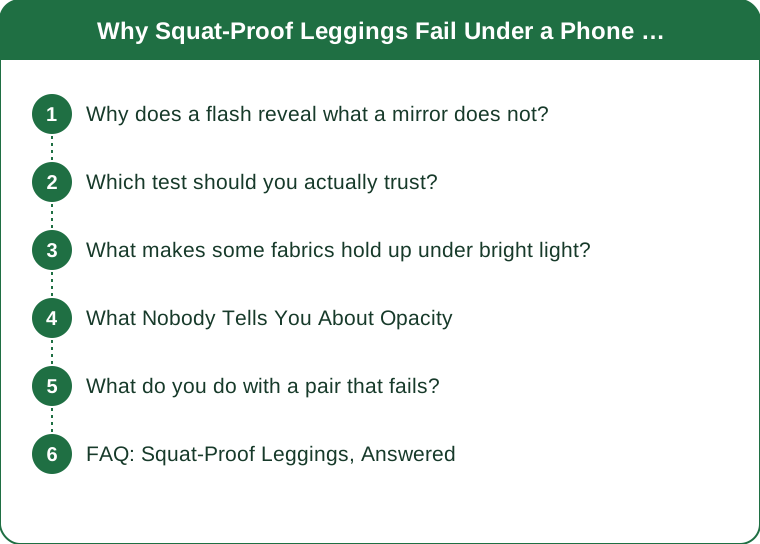
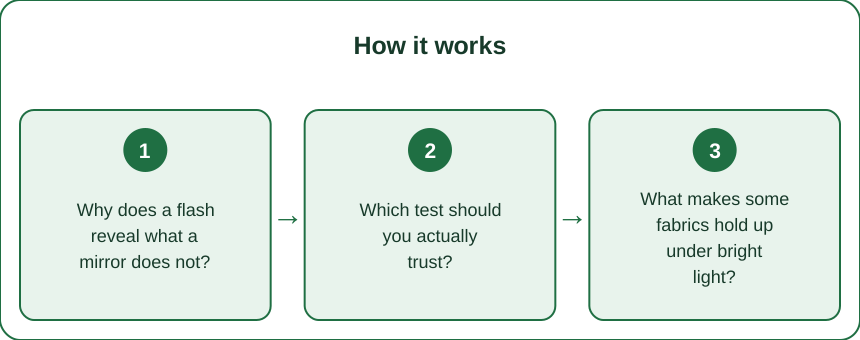
Why does a flash reveal what a mirror does not?
Because of intensity, direction and distance.
Opacity is not a fixed property. It describes how much light passes through a material, and that depends entirely on how much light is hitting it and from what angle.
Room lighting is diffuse — it arrives from many directions, bounces off surfaces, and is relatively weak at any single point. Fabric with a slightly open knit blocks most of it, because the light reaching any given point of the fabric is limited.
A camera flash is the opposite. It is intense, it comes from one point, and in a photo taken a metre or two away it is close. That combination pushes far more light through the same gaps in the knit, and what is behind the fabric becomes visible.
The same effect appears with direct sunlight, with a single bright overhead spotlight, and with the harsh downlights common in gym studios. Flash is simply the most extreme version.
So the mirror test is not wrong — it is testing indoor diffuse-light opacity. The flash test is testing something more demanding, and which one matters depends on where you wear them.
Which test should you actually trust?
Match the test to the conditions you will be in, and run more than one.
The bend-over mirror test in normal room light tells you about ordinary indoor use. Adequate for most gym settings.
The phone flash test — have someone photograph you bending in the leggings with the flash on, or use a torch held close — is the most demanding. Appropriate if you train in a studio with bright spotlights, take photos, or attend anything filmed.
The daylight test is the one most people skip and the one that matters most for outdoor use. Bend in front of a window with the sun behind you. Direct sunlight is intense and directional, and it is far more revealing than any indoor lighting.
The stretch test removes lighting entirely. Stretch the fabric over your hand and look at how much skin tone shows through. This tells you about the fabric itself rather than about the lighting.
A sensible standard: pass the bend-over test in room light and the stretch test comfortably, and know where you stand on the flash test. A legging that fails the flash test is not unwearable — it simply has a narrower set of appropriate conditions than one that passes everything.
What makes some fabrics hold up under bright light?
Several factors, and thickness is only one of them.
Weight, measured in grams per square metre. Higher-GSM fabric has more material in the same area. Around 250-300 GSM is typically robust; below 200 tends to struggle under bright light regardless of other qualities.
Knit density. How tightly the yarn is packed. A dense knit at moderate weight outperforms a loose knit at higher weight, which is why GSM alone is an incomplete guide.
Yarn type. Textured or spun yarns scatter light more effectively than smooth filament yarns. This is why a matte fabric usually outperforms a shiny one of the same weight — the shine indicates smooth filaments that transmit light more readily.
Colour. Black and deep colours absorb more transmitted light. Light greys, pastels and anything close to skin tone are the hardest to make opaque, which is why they are the colours that fail most often.
Double-layering. Many genuinely squat-proof leggings use a double layer or a gusset panel through the seat. This is the most reliable single indicator, and it is often mentioned in product descriptions if you look.
And the thing that changes over time: stretch recovery. As elastane degrades, the fabric sits under more tension at the same size, the knit opens slightly, and opacity falls. A pair that passed every test when new can fail after a year without looking any different.
What Nobody Tells You About Opacity
Stretch is what causes sheerness, not thinness. A fabric stretched 40% has the same amount of material spread over more area, so the knit opens. This means opacity is a fit issue as much as a fabric issue — the same leggings in a size larger are frequently opaque where the smaller size is not.
Sizing down never improves opacity. People do this constantly, hoping for a more secure fit, and it makes sheerness worse in every case.
What you wear underneath changes the result significantly. High-contrast underwear shows through fabric that is otherwise fine. Seamless underwear matched roughly to your skin tone is far more forgiving than either white or a strong colour.
Moisture increases sheerness noticeably. Wet fabric transmits more light, which is why leggings that are fine at the start of a session can be a different proposition by the end of a hot one.
Temperature matters through elastane behaviour. Warm fabric is more elastic, so it stretches further at the same tension. A pair that passes a test in a cool changing room may perform slightly worse in a heated studio.
Ribbed and textured fabrics are more forgiving because the surface variation breaks up whatever shows through. Smooth matte fabrics show the most.
Nobody in your class is examining you. This deserves saying, because the anxiety generated by this topic is significantly out of proportion to the observation actually taking place. The practical concern about photographs is legitimate; the concern about being scrutinised mid-squat generally is not.
What do you do with a pair that fails?
They are not necessarily finished — it depends where they fail.
If they fail only under flash or direct sun, keep them for indoor sessions under normal lighting. Most gyms qualify.
If they fail the stretch test on your hand, they were never opaque and no lighting condition rescues them.
If they used to pass and no longer do, the elastane has degraded. This is a replacement situation rather than a care situation, though it is worth checking whether tumble drying caused it, since that would apply to the next pair too.
If they fail only in one area, usually across the seat, that is the highest-stretch zone doing what it always does. A longer top solves it entirely and is what most people do.
If they fail because of what is underneath, change that first. It is the cheapest variable and it resolves a surprising number of cases.
When buying the next pair: look for a stated GSM above 250, a double-layer or gusset in the seat, a matte rather than shiny finish, and a darker colour if opacity is your priority. Buy your true size rather than sizing down, and run the stretch test before removing the tags. Any retailer worth using will accept a return on unworn leggings that fail an at-home opacity check, and that check takes ten seconds.
FAQ: Squat-Proof Leggings, Answered
Does price predict opacity?
Weakly. There are inexpensive leggings with dense double-layer construction and expensive ones in fine, light, deliberately sheer-adjacent fabrics. The specifications — weight, layering, finish — predict it far better than the price does, and they are usually available if you look at the product detail.
Why does one colour of the same legging fail when another does not?
Because dye and pigment affect light transmission. Darker dyes absorb more transmitted light, and light colours near skin tone provide the least contrast with what is behind them. It is common for a brand’s black to be genuinely opaque and its light grey in the identical fabric not to be.
Do I need to retest a pair I have owned for a while?
Worth doing annually if you wear them regularly. Elastane degrades gradually and the change is invisible until you look for it — a pair that has been through a year of washing sits under more tension than it did new, and the opacity goes with it.
TL;DR:
- A flash is intense, directional and close, which pushes light through a knit that diffuse room lighting cannot penetrate.
- Match the test to your conditions: mirror test for indoor gyms, flash and direct daylight tests for studios and outdoor use.
- Opacity comes from weight above ~250 GSM, dense knit, textured yarn, darker colour, and double-layer construction.
- Sheerness is caused by stretch, so sizing down always makes it worse — and moisture, heat and elastane age all reduce opacity.
- A pair that fails only under flash is still perfectly usable indoors; a pair that fails the stretch test never was opaque.
The single most useful thing to take from this is the ten-second stretch test over your hand before you remove the tags. It tells you about the fabric rather than about the lighting in one particular room, and it is the only test that gives you the same answer in a changing room, a sunlit park, and someone’s photograph.
See It in Motion
Seen here: High Waist Yoga Leggings with Side Pockets — shop it on bubblelime.com
Keep Reading
This article is for general informational and styling purposes only. Fit, sizing, and product availability may vary.